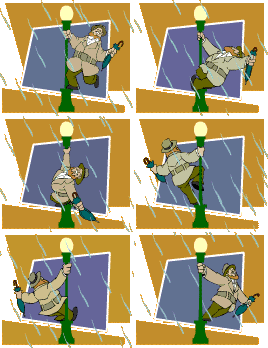
I am – Hercules!!
Who is Alexandra DuPont? Imagine Morena Baccarin crossed with a pre-Billy Bob Angelina Jolie and a 19-year-old Monica Bellucci. Your dream girlfriend, only taller, smarter, skinnier, cuter, more scantily clad and without the crazy.
Convinced for a time that her breakthrough experimentations with coherent light and the human genome project were somehow more important than reviewing movies, young Lexy for a time appraised only projects tied to her oldest and most reviled archnemesis, George Lucas. But it appears that, for her last Ain’t It Cool News appearance, she’s expanding into Joss Whedon territory as well.
You heard me right: this is her last AICN post ever, and it’s a bittersweet day for those of us who have long labored beside her. DuPont started here in 1999 and turned out to be such a gifted wordslinger (some, myself included, regard her as this site’s all-time best) that she now enjoys (under another name entirely) a major career as a highly paid, nationally published entertainment journalist.
And, as a consequence, she is done writing free stuff for our sorry asses. But least she’s going out reviewing two (in my view) spectacular big-screen entertainments, to say nothing of the year’s most talked-about.
Entirely too many mainstream reviews of
this film will use the headline 'Return of the Jedi':
ALEXANDRA DuPONT's SPOILER-PACKED 'REVENGE OF THE
SITH' FAQ
ALEXANDRA DuPONT's SPOILER-PACKED 'REVENGE OF THE SITH' FAQ
Q. So you saw "Revenge of the Sith?
A. I did.
Q. Give us a four-word review.
A. Bloody hell! It's good!
Q. You're not one of those prequel apologists, are you?
A. Please:
My "Phantom Menace" review, 1999: "Those of you waiting in line for Star Wars: Episode I: The Phantom Menace are, in my opinion, setting yourselves up for a grave disappointment. Either that, or you're about to brainwash yourselves into the short-term, delusional embrace of a sub-par cinematic product - which is even worse."
My "Attack of the Clones" review, 2002: "If these last two Star Wars movies have taught me anything, it's that all my prior rantings about Star Wars needing to be mythologically and thematically coherent and profound no longer apply. Those rantings were, in retrospect, most likely the justifications of a young adult who wanted to explain why she'd liked a pulp sci-fi/fantasy series so emphatically - and who gleefully adopted as her own the 'Power of Myth' mental gymnastics handed to her on a platter by Joseph Campbell and the Lucasfilm P.R. machine."
Not only that, but I'd read the "Revenge of the Sith" screenplay and thought it was one of the worst piles of over-expository, ill-structured offal I'd ever read. Some "favorite" quotes:
SUPER BATTLE DROID: Don't move, dummy. Ouch! Zap this.
or
MACE WlNDU: Aarrrrggghhhhh . . . Aarrrrggghhhhh . . .
Or even what read, on the page, as maybe the single most abrupt transition to evil in the history of movies:
ANAKIN: What have I done?
ANAKIN sits.
PALPATINE: You are fulfilling your destiny, Anakin. Become my apprentice. Learn to use the dark side of the Force.
ANAKIN: I will do whatever you ask.
I mean, really: "Anakin sits"?! Why not just hand him a latte while you're at it?
Between that and the dull footage from the Trivial Pursuit "Star Wars" edition that came out a few weeks ago, I walked into the "Sith" preview screening expecting to be appalled, insulted, bored and almost suicidally depressed over my misspent youth - which would have led, frankly, to a much funnier review than the one that follows.
Q. So you liked "Revenge of the Sith"?
A. I may have even loved it a little.
Q. What, were you bribed?
A. Only by quality, dear reader. Only by quality.
The bottom line is that "Sith" has a discipline - an aggressive discipline - missing from Episodes I and II. It is just repeatedly not-embarrassing at nearly every turn. Most of the flabby expository walks to landing pads have been neatly snipped. Important things are said with images instead of words. The special effects are better, but draw less attention to themselves.
Putting it another way: The first two prequels are what I call "landing strut" movies. Before digital effects, showing a spaceship extending its landing gear and plomping to the ground with any sort of believable physical weight was difficult; you only see it a few times in the original trilogy, and most of that turns up in "Return of the Jedi." But the prequels are just chock-full of landings and gear-extending and dust kick-ups, and a landing sequence was actually lengthened in "The Empire Strikes Back Special Edition." Is this because showing these landings was somehow crucial to the advancement of the story? No; it's because ILM now had the technical ability to show them. And of course, in narrative terms, it plays like a movie full of people parking their cars. "Revenge of the Sith" mostly avoids that, despite featuring an unholy amount of commuting - more than in the previous two prequels combined, I think.
Putting it yet another way: Jar-Jar Binks is in two crowd shots in "Sith." And he never says a word.
Q. But I was hoping Jar-Jar would have a redemptive character arc or be killed by Anakin! And what about that rumored guest appearance by Quinlan Vos?!
A. Maybe you should stop reading this review. One of the best things about "Revenge of the Sith" is that it jettisons every supporting character or subplot (with the exception of General Grievous and some nice-looking stuff involving Wookiees; more on them in a second) that doesn't move the story forward.
Here's another example: Remember Padme's bodyguard, Captain Typho? He has one or two lines. In a single long shot. Thank God.
Q. So how is it that this movie is so much better than the last two?
A. I have my suspicions. First of all, there was just more mandatory story that had to be told: The Clone Wars had to end, Anakin had to be seduced by Palpatine and the Dark Side of the Force, the Anakin/Padme romance had to end tragically, twins had to be born and hidden, Darth Sidious' co-conspirators and the Jedi Knights had to be wiped out, and there had to be an absolutely bitchin' lightsaber duel, preferably with lava, that ended with Anakin being set ablaze.
Q. So that's the story of the movie, then?
A. Pretty much. It's actually a little less Gothic than that in its overall vibe. And it moves. There are scenes that consist, in their entirety, of people walking down a hallway and talking urgently for 10 seconds, with transition wipes on either side - very "New Hope." (It's especially "New Hope" considering that, in one instance, said hallway is in the Rebel Blockade Runner Tantive IV, which was just geektastically wonderful to see.) The movie can be divided into four fairly tidy sections:
(1) An opening space-battle / rescue / lightsaber-melee / crash-landing that more or less captures the scruffy fun of "A New Hope." After the title crawl, we pan down to a Star Destroyer and a wicked opening shot. It feels like an announcement: "Please relax and feel free to giggle, as we'll be kicking it old-school for the next 20 minutes."
(2) Then the film crash-lands on Coruscant for a little while as everyone has trysts and meetings and conspires a bit. These scenes are considerably more compelling than their counterparts in the last two films, but there are still a few too many of them, and I was beginning to get nervous. And then:
(3) Anakin's final seduction is intercut with Yoda and Obi-Wan off having jaunty adventures that serve little purpose beyond getting the two of them away from the soon-to-be-set-ablaze Jedi Temple. That said, these are relatively fun diversions - and certainly no more silly than having Han and Leia land in the gullet of a giant space slug.
(4) And then Anakin turns. And the movie turns into a surprisingly moving opera. There were tears at my screening; the scene where The Mask is dropped on Anakin's head as he's vacuum-sealed into The Suit produced horror-movie chills. Spielberg isn't spinning you this time. It's that good.
Q. So back to the previous question, because I'm still having trouble believing your turnaround: How is it, again, that this movie is so much better than the last two?
A. Well, second, and this is just a pet theory, I think Spielberg and Coppola - possibly the only two guys on earth in a position to tell Mr. Lucas when he's doing something wrong - rode him early and often on the subject of "Sith"'s pacing and structure and its desperate need to lack robots who call each other "dummy."
(BTW, that "dummy" moment is in the Trivial Pursuit footage, but it's nowhere to be found in the final edit - marking possibly the first time a "Star Wars" prequel's sneak-peek footage has been improved upon by the final edit.)
Third, Lucas hired Francis Ford Coppola's dialect coach, and it shows. All "Star Wars" dialogue is vaguely formal and/or silly - been to Tosche Station lately? - but delivered with proper conviction, the words have, at times, taken on an alien, timeless quality that feels a bit like myth. In "Sith," there's a lot less of the cloying, stalkerish love-prattle between Anakin and Padme that nearly unmanned "Clones," but what little there is is delivered in the zip-code of believability - even by Natalie Portman, a great actress who couldn't have sounded more embarrassed during the preceding four hours and change.
Fourth, and even better, vast swaths of story are told without words - with tons of Coppola-esque cross-cutting - backed by a John Williams score that now sounds deeply, powerfully sad where it sounded kind of dull to me just a few days prior.
Two of my favorite examples of this involve, incredibly, Anakin and Padme.
We first see Padme in this film standing in the shadows behind a pillar, in that ridiculous but weirdly nostalgic cinnamon-bun hairdo, watching Anakin walk away from his latest feat of derring-do. She has a look of nervous longing - she's about to tell Anakin she's pregnant - and this silent moment says more about their relationship than the entire previous film. Then, later, as Anakin sits alone in the Jedi Temple, wondering whom he should be helping - Palpatine or the Jedi about to arrest Palpatine - he looks across the city at Padme's apartment. At the same time, she's looking across the city at the Jedi Temple. The calm, wordless connection that follows - all of it accomplished with special effects and digital cameras and a couple of discreet zooms - may end up going down as one of the great "Star Wars" moments.
The floor is now open for questions.
Q. Is this the greatest "Star Wars" movie ever?
A. Not even close. That honor still belongs to "Empire," followed closely by "A New Hope." Both those films have an urgency to them that "Episode III" could never muster. But "Sith" edges out "Jedi" - if only because "Sith" lacks Ewoks, and because "Sith"'s Emperor comes off as more than a cackling, flour-dipped prune who speaks in sound bites while lightning spews out of his fingers.
Q. So Ian McDiarmid gives another great performance, does he?
A. He surpasses every expectation I had for the Palpatine/Emperor transformation. This is not said lightly. In "Revenge of the Sith," you actually understand where he's coming from.
You actually, in a way, kind of like him.
Mr. McDiarmid - even in the very awful "Star Wars" movies, of which there are two - has demonstrated a gift for rolling silly lines around in his mouth and making them sound like Shakespeare. (I'm a huge fan of the way he says "I love democracy!" in "Clones.") He's one of those classic, classy actors who actually seems to relish delivering his lines, without embarrassment, like he's facing off against Basil Rathbone in a 1930s serial. When Palpatine finally emerges in all his evil, lightning-scarred glory, sound designer Ben Burtt gives McDiarmid's line deliveries a sort of deep-bass echo - as if every word were traveling through Palpatine's larynx after being sung by a chorus in the bowels of Hell - and it is just wicked to the ears.
But in "Sith," McDiarmid also gets to lay out a coherent philosophy to Anakin during one of their many confrontations. "Anakin, if one is to understand the great mystery, one must study all its aspects, not just the dogmatic, narrow view of the Jedi," he says, quite sensibly. "If you wish to become a complete and wise leader, you must embrace a larger view of the Force. "
You know, who wouldn't get behind that?
Please notice that I keep bringing up the non-action bits as great moments in the film. Given what's come before, do please note how incredible that is. One of my favorite scenes is the one where Palps begins working his seductive magic on Anakin in an opera house. It's like something out of "The Godfather," and McDiarmid knows precisely how much fun to have with every melodramatic syllable. (Nor is this the only blatant Coppola reference in the film; there's a moment where a grim-faced Yoda is talking to Anakin in front of some closed shades, with sunlight slatting the wee Jedi Master's face in chiaroscuro, and I half-expected Yoda to mutter "Fuckin' Saigon." Someone has actually Photoshopped "Apocalypse Now Yoda" somewhere - I vaguely recall seeing it in a Fark.com comment thread - and I'd love to see it linked in TalkBack.)
Q. But what about that horrible scripted moment, reproduced earlier, where Anakin does this one-sentence flip from good to evil?
A. In the telling, it's a bit more complicated than that. It's still not perfect, but it's at least worthy of debate. Some of the onscreen flip is non-verbal, but it's also just a long time coming, and there's never really a clean or immediate turn to evil. The overall sense in "Sith" - which doesn't necessarily come across in the text - is of a set of tumblers clicking into place, locking Anakin into his destiny. It's surprisingly tidy and kind of merciless.
I love that Anakin is caught by both pride and a lie. He wants to learn the Dark Side of the Force to give Padme eternal life, but he's also fooled by Palpatine into believing there's a genuine Jedi conspiracy against the Chancellor. When Anakin bursts into the room at one crucial moment, all he sees is Mace Windu holding a lightsaber to an unarmed Palpatine's throat - and after what follows, no one really gets a chance to dissuade him from the notion that Mace was about to assassinate the man who runs the galaxy. For all I know, when he meets Obi-Wan again on the Death Star a couple of decades later, Anakin still thinks the Jedi hatched a plot to kill his boss.
And finally - and this is a credit to Hayden Christensen's performance - Anakin gets a few tender moments with Padme even after he's slaughtered a roomful of children. He's not "evil" in the 2-D, mustache-twirling sense until the final duel with Obi-Wan, and maybe not even then. Again, it's surprisingly complicated.
Q. So how is that final lightsaber duel? Is it wickedly awesome?
A. It's impressive, but not earth-shatteringly great. The Darth Maul duel in "Phantom Menace" had far less drama, but better moves. I also could have done without the "Frogger"-ish bit on the (conveniently platform-like) lava robots, although I loved it when Anakin chased Obi-Wan up a spire that's slowly sinking into the magma. (My life partner saw some footage from The Duel and said it looked like the Burning of Atlanta from "Gone with the Wind," only with lightsabers, and that sounds about right.) But we're in a post-"zowie" era when it comes to special effects and fight choreography, in my opinion; nowadays, moviegoers only tend to be exercised into opinion by effects when they're poorly done. So I was more interested in the drama within The Duel - in the way Obi-Wan is essentially in retreat for the entire battle; in the way he's actually doing a fairly inept job of trying to pull Anakin back from the brink of evil - than I was in how fast or well-choreographed or lava-coated the whole affair was.
This is, of course, exactly as it should be.
Q. Is the film a hard PG-13, like Lucas keeps insisting it is?
A. Eh, Georgie's just spinning. This movie's actually fairly bloodless - most of the worst violence is implied or conveniently hidden by colorful giant mushrooms (you'll see what I mean) - and it's certainly no harsher than "Return of the King." The Jedi who gets set ablaze doesn't even leap off a mile-high cliff afterward!
Q. So General Grievous coughs, huh? Is that as stupid as it sounds?
A. Yeah, it's kind of silly, even if you've seen (and enjoyed) "Clone Wars Vol. 2," which attempts to explain said cough as the result of a final Force fuck-you from Mace Windu. But again, like every problematic aspect of this film, it's just not the deal-breaker it would have been in the last two prequels. You'll see what I mean. Plus, the shot where Grievous is coming at Obi-Wan with four lightsabers - two of them twirling like plasma saw-blades - is one of my favorite images in the film.
Q. Is Chewbacca cool?
A. He's completely extraneous - appearing in, like, five shots during the brief digressions on Kashyyk. If Yoda hadn't said his name at one point, a less-careful viewer might not even notice it was Chewie.
Q. Were there any fun little background details?
A. I caught two:
(1) Keep an eye on the lower part of the screen during an early shot where we're approaching this massive bi-level parking garage, and you'll see a very tiny Millennium Falcon coming in for a landing.
(2) In the delegation that greets Anakin after his crash landing, I swear there were some robot hotties off a "Heavy Metal" comic-book cover, or maybe they were meant to riff on Maria from "Metropolis," or maybe there were simply executions of McQuarrie's concept-art version of Threepio. I'm not sure, frankly, but they looked very Deco and cool.
Q. Is there any great John Williams music that didn't find its way onto the soundtrack album?
A. Yes. Entirely too much music from the opening space battle and the final, wordless montage - which finds Darth Vader on a Star Destroyer and a dead Padme covered in flowers - was left off the album. (Williams geeks will know what I'm talking about here: Unless my memory is failing me, the music from "Qui-Gon's Funeral" actually accompanies the suiting-up of Vader, not Padme's death processional. I was a little surprised at this - pleasantly so, I might add.)
Now, all that said, as in "Episode II" there's quite a bit of re-tracked action music borrowed from previous prequels. This isn't as obnoxious as it was in "Clones," however, and I had no sense of Williams' work being mangled by Ben Burtt this time around.
Q. Does "Sith" make "Phantom Menace" and "Clones" better movies?
A. Not so much. You do see the groundwork Lucas was trying to lay in those films a bit more clearly, but said groundwork turns out to have been almost totally unnecessary - "Revenge of the Sith" is surprisingly self-contained. I'll be pretending that "Sith" is Episodes I-III combined, myself. And I won't be alone in doing so.
Q. Does anyone mention the dreaded midiclorians?
A. Yes. In the opera scene, if memory serves. Palpatine basically brings them up in a way that suggests, fairly subtly, that he manipulated the midiclorians to bring about Anakin's "virgin birth." The Throne Room scene in "Jedi" may be a three-generation family reunion of sorts, though we'll never know for sure.
Q. So they don't explain Anakin's virgin birth in detail? I'm angry!
A. What is this, "Star Trek"? I'm delighted that this - and Palpatine's transformation from regular old guy to yellow-eyed-fright-mask old guy - are dealt with in ways that leave them open to discussion.
It actually ties into why I'm in such a good mood about this film overall: It's actually worth discussing - and not just in those exhausting "did it rock or did it suck?" back-and-forths where everyone's a loser.
"Revenge of the Sith" is, in its simple way, a film of ideas - with a surprising ambivalence about Anakin's evil and the flabbiness of the Jedi bureaucracy. ("The Prophecy of the One Who Will Bring Balance to the Force" takes on some new wrinkles here, because it becomes apparent that a huge part of that prophecy involves tearing down the Jedi bureaucracy, which is in fact too "dogmatic" for its own good. Harsh!)
I had no idea Lucas had a movie like this left in him, and I can't wait to see what he does next. As a much-abused fan who came of age during the first trilogy's original release, I'm overjoyed; after I saw "Sith," I actually stared at a blank Word document for a full day before all these words poured out, because I couldn't figure out a way to put my relief into sentences. (Obviously, I've since solved that problem with a vengeance.) I think you'll feel the same way.
I'll answer any additional questions in TalkBack if I can.
AND NOW, A LONGISH DISCUSSION OF
'SERENITY'
It's a transitional time for fandom.
Most of the major geek franchises are rolling flaming across their finish lines. "Star Trek" just lolled off the air. "Star Wars" is migrating to TV. The Wachowskis reduced the "Matrix" audience to - what? - the Venn-diagram intersection of philosophy undergrads, S&M aficionados, wuxia geeks and wankers in denial? And the rights to "The Hobbit" are currently being pried apart by the jackals of finance.
Sure, there's hope. "Star Trek" could return as an era-spanning anthology series (with John Saxon finally cast as the starship captain he was born to play). Lucas' throat pouch, fattened with home-video revenue, could produce some exciting new experimental films. And, if there's a God, the "Hobbit" rights will be freed in time for Martin Freeman to play young Bilbo. But still: The geek landscape is about to change. And people, and also studio executives, are mildly curious about what the Next Big Thing is going to be.
And so I've been following "Serenity" test-screening reviews with great interest. And I've noticed that everyone keeps asking variations on the same questions:
Will Joss Whedon's "Unique Vision of the Future"™ be the next big franchise? Can a sequel to a cancelled TV series bring Joe and Jane Sixpack into the theater? Will toy and DVD sales bury Mr. Whedon in a mound of mainstream success and cocaine?
Well, now that I've seen an unfinished version of the film with an audience full of rabid "Firefly" fans, I have an answer to those questions:
Who cares?
Really. I could give two gerbil poops about whether this film has "mainstream appeal" or not. Allow me to quote "True and False," David Mamet's excellent guide to surviving show business: "Do you desire the good opinion of these people? Are not these the same people you told me yesterday were fools and charlatans? Do you then desire the good opinion of fools and charlatans? That is the question asked by Epictetus."
Last I checked, "Serenity" wasn't a pop song. Worrying about its popularity is antithetical to the founding precepts of geekery. The key to "Serenity"'s future doesn't lie in appealing to non-fans, but rather in creating new fans. I want the film to succeed, so I'll be showing the "Firefly" DVDs to as many people as possible in the next five months.
Because "Serenity" - if the studio doesn't royally pooch it in the coming weeks - works as a loving, slightly flawed "Firefly" season finale. And it emotionally slays anyone invested in these characters.
Q. So you're not a prequel apologist - you're a "Firefly" apologist!
A. Oh, God, yes.
Q. Why?
A. I loved the show. "Firefly" didn't give a shit about landing struts, manufactured cool or the preciousness of its own "mythology." It was, first and foremost, a story about people. If "Revenge of the Sith" is about the elites in a galactic society, then "Firefly" - like "The Fifth Element" or "Red Dwarf" - was about the working-class stiffs who take out their trash. To me, that was interesting. And funny.
Q. Let's pretend I've never seen the show and can put aside my knee-jerk snark for a moment. Explain "Firefly"'s appeal in pithy sentences.
A. Well, you can read this very fine summary at Wikipedia, or scroll down if you just want to read about "Serenity." But here goes:
"Firefly" follows the smugglers and passengers on a Millennium Falcon-like cargo ship named Serenity. Humanity is re-living the days of the Old West (if the Old West had belly-dancers and hover-cars) as it settles a new solar system.
Serenity's captain, Malcolm Reynolds - played by Nathan Fillon (whom my life partner calls "Jason Boxleitner" for reasons that become obvious if you've seen Fillion's hair) - was one of the losers in an interplanetary civil war. Now he's an outlaw - robbing trains, smuggling cattle and damn well shooting Greedo first.
He's helped (and occasionally betrayed) by his large, bickering crew. This includes a wisecracking pilot (Alan Tudyk); the pilot's "warrior woman" wife (Gina Torres); a two-fisted hick (Adam Baldwin) with a t-shirt collection you can buy online; an adorable mechanic (Jewel Staite); a preacher with a past (Ron Glass); a courtesan (Morena Baccarin); and a doctor (Sean Maher) who rescued his psychic sister (Summer Glau) from a government program that turned her into a lethal schizophrenic.
Q. It sounds like an overstuffed "Cowboy Bebop."
A. You're in the ballpark. Take "Bebop"'s crazy East-West blend. Add the shaggy adventure of '70s-era "Battlestar Galactica" and "Buck Rogers." Remove every scrap of idiocy those last two additions imply. Stir in a hearty dose of classic Westerns and Brian Daley's Han Solo novels. And you're starting to get an idea of the show's vibe.
Q. That sounds ... dense.
A. Even Whedon jokes about how it's impossible to boil the "Firefly" pitch down for Hollywood suits. But the cast was usually smeared with grime and dripping with sweat, and dear Lord it may have been the most across-the-board sexy ensemble I've ever seen on television. Even Ron Glass was buffed-out.Q. So who was the "Firefly" equivalent of Willow? I must crush on her immediately!
A. While Baccarin was the show's official "hottie," I gather that male geeks hold a special reverence for Staite's mechanic, Kaylee - a total sweetheart of vague ethnicity who was about 15 pounds heavier than the stick-figures passing for "sensual" on TV. I was also personally blown away by the unlikely hotness of Tudyk and Torres, who played the ship's married couple; what looked at first glance like an unholy mating of Howdy Doody and FloJo quickly became one of my favorite television couplings ever.
Oh, and the show was funny. My favorite "Firefly" scenes were, I kid you not, the ones where everyone laughed and argued around the ship's dinner table. There were also a lot of weird little grace notes: For example, everyone spoke in this quaint Asian-cowboy patois where they'd say stuff like, "This place gives me an uncomfortableness," then curse in Chinese.
Q. That sounds stupid.
A. It was, truth be told, a sticking point for some viewers. But the actors pulled it off with panache. To me, "Firefly"'s love of language was its greatest joy.
Q. Well, then, it sounds like a total chick show.
A. No. It's more that "Firefly" was aimed at actual grown-ups. (Judging from last week's 10 p.m. screening, Browncoats tend to be college-age and older, though there were a surprising number of female geeks on hand. Lonely young men might consider converting now.) And, as with "Buffy the Vampire Slayer" or "Angel," all the grown-up stuff was liberally sprinkled with arse-kicking.
Give it a chance. You won't be sorry.
Q. Fine. I'm a convert. How's "Serenity," already?
A. Well, writer-director Whedon takes all of the above and vacuum-packs it into 130 minutes - only with better lighting (by Eastwood cinematographer Jack Green), and, oddly, what felt like slightly clunkier action photography.
I really, really want to praise the film's opening 10 minutes. Whedon manages to explain the backstory of the "Firefly" universe in the form of a school lesson. Then he flash-forwards to Simon Tam's (Maher's) rescue of his sister River (Glau). Then he introduces The Operative (Chiwetel Ejiofor), the nameless assassin who finally explains why the government wants River back so very badly. And then - in an absolutely splendid bit of filmmaking - he introduces the Serenity, Capt. Reynolds and his entire crew in a single, witty tracking shot that takes us through the entire ship as it buckles on re-entry. These first 10 mins. are mostly artful and succinct, and were probably murderously hard to write.
Q. So why is the government so anxious to get River back?
A. This comes to light almost immediately, so I guess there's no harm in sharing: It turns out the doctor experimenting on River was showing her off to key members of Parliament. Apparently, the government is worried that River may have read the minds of those visiting officials - men who knew some very alarming state secrets.
Q. What are the very alarming state secrets?
A. To borrow a phrase from my dear colleague Hercules: That would be telling. And you'll never guess what they are. But once they're revealed, Whedon blows his TV universe wide open. - finally giving the disillusioned Mal something to believe in - as the film ....
(a) more or less resolves the whole lethal-schizophrenic-sister storyline;
(b) tackles this new (and sort of out-of-the-blue) conspiracy; and
(c) spends quite a bit of time with the "Reavers," spacefaring rapist cannibals who string bodies to the sides of their ships and howl like the zombies in "28 Days Later" (which leads me to wonder how they can get it together long enough to build and fly spaceships, but still).
It's a very generous movie. When the film ended, everyone sort of blinked, clapped and gushed about how far the film had traveled - a feeling I relish after any well-told adventure story. Serious fans were literally shaking with emotion. There were, in many quarters, tears. The story would have played wonderfully (maybe even better than "Serenity" does, frankly) as a multi-episode TV-series arc - which I'm sure is what Whedon originally had in mind.
Q. There was crying? Oh, God - does someone die?
A. Again, that would be telling. But anyone familiar with the Buffyverse knows that Mr. Whedon can be a bit cavalier with the human life.
Q. SERIOUS "FIREFLY" GEEK QUESTION No. 1: Which episode of the series does "Serenity" most resemble?
A. The first half plays quite a bit like the two-hour pilot - also titled "Serenity" - only faster-moving. Any scene where The Operative is chasing (or roundly kicking the collective fanny of) the crew feels a little like "Objects in Space" - though Ejiofor is playing a character who's saner, cooler, smarter and far more dangerous than Jubal Early.
The middle - with its crucial revelations about River and its unfamiliar environs - bears the faint whiff of "Ariel," my personal favorite episode. Any bits with the Reavers are logical extensions of "Bushwhacked." And the final showdown plays like a cranked-up version of the space-station siege in "War Stories," only crossed with one of those highly caffeinated modern zombie movies.
Q. SERIOUS "FIREFLY" GEEK QUESTION No. 2: Who in the cast gets short-shrift?
A. It was, of course, a profound pleasure to see everyone onscreen again - though both Maher and Fillion take darker, crankier approaches to their characters this time around.
But, as with any nine-person group that isn't a jury, someone was bound to get ignored.
Tudyk, Maher and Staite all get off some good lines, but they also tend to recede into the background in favor of Fillion, Torres, Glau and Baldwin. (Glass and Baccarin aren't even on the ship when the film begins - Glass in particular is almost a "special guest star" in "Serenity" - and Baccarin all but disappears in the over-edited final siege, during which she wears a very cute top.) Also, the Tudyk/Torres marriage is reduced to a couple of "honey"s and "Yes, dear"s, though this is hardly unexpected.
Q. SERIOUS "FIREFLY" GEEK QUESTION 3: Is there sound in space?
A. In the print I saw last week? Sometimes there was and sometimes there wasn't. Universal appears to be testing it both ways. With the right music, I'd personally prefer the final, largish space battle to play out in scientifically correct silence; it might be a little less geographically confusing that way. That said, I'm not holding my breath (as it were).
Q. What else is good?
A. (1) River is considerably less annoying than she could occasionally be on the series - there's a focus to the way she's written here that I personally appreciated. She also does some nice damage with her weird, silly brand of ballet-fu; someone should drag Kurt Thomas out of retirement and cast Glau against him in "Gymkata 2: Dancekata!" post haste.
(2) The scene where Mal and the Operative first face off at Inara's Companion school is terrific - filled with comedy, cool menace, and some very amusing beatings of Captain Tightpants, who takes his whole "Han shoots first" ethos to ridiculous extremes throughout the film, God bless him.
(3) The "Firefly" wisecracks? They're here. Some might say they sound "a little too TV"; I say they sound "funny." Baldwin in particular delivers some smashing one-liners as the vaguely mutinous Jayne Cobb - even with a spear through his leg. He's just hilariously tough and stupid, and there's a great scene where he chews out Mal in the dining room during which I swear to God I thought he was going to get shot for lipping off.
(4) The show's essential humanity is intact. This was, by far, my biggest concern.
Q. What's not so good?
A. Now, before I get into this, I want to say that the movie works overall, and that this 10 p.m. "Serenity" sneak-peek screening will stand as one of the finest moviegoing experiences of my relatively young life. There was singing. There was bonhomie. There was a touch of that good-natured Southern courtliness that was such an infectious part of "Firefly," only tinged with the light Asperger's of the serious fan - qualities I find passionate and real in controlled doses. There was, in short, an utter minimum of jackassery, and being in that auditorium summed up all the best reasons I've written for AICN off and on for over half a decade.
This was especially true given that Joss Whedon had filmed a rather lengthy, hilarious and emotional monologue - specifically addressed to us - that was shown before the movie (and if it isn't on the "Serenity" DVD, I fear pitchforks). "In Hollywood, they call people like you and me unrealistic and quixotic," he said, more or less. "In my world, they're called Browncoats."
This was, of course, met with cheers and maybe even a light collective choking-up.
"In an unprecedented way, it's your movie," he continued. "And if it sucks, it's your fault."
"Serenity" doesn't suck. Not by a long shot. But there are a few spoiler-y and occasionally nit-picky problems I want to point out, because I'm of the hope that they can be at least partially addressed over the next few months:
(1) As mentioned earlier, the Reavers don't entirely make sense as spacefaring zombie idiots. Their ability to rappel and plan attacks and, presumably, maintain and navigate largish spacecraft seems at odds with the howling, face-carving, suicidal-throwing-yourselves-at-bullets tendencies exhibited late in the film. This could be fixed if I witnessed one Reaver saying or doing something vaguely intelligible - just once - that didn't involve the throwing of spears. Pushing a button on the bridge of their ship, even.
(2) Along those lines: It's kind of a shame that the offbeat, quirky charm of the first four-fifths of "Serenity" gives way to the sort of armed standoff we've seen in genre pieces before - up to and including, without getting into too much detail, an obstacle-course showdown between hero and villain that includes dangling and leaping in a massive technological Macguffin Resolution Device that is, inexplicably, abandoned and well-lit, a la the climax of "I, Robot." This may be an unavoidable casualty of both budget and subject matter, but there it is. All this was mitigated by my concern for the characters, but still.
(3) There is a character in "Serenity" named "Mr. Universe." Mr. Universe apparently lives with his lifelike sex-doll in a vast telecommunications complex manned by him and him alone. He is surrounded by artfully arranged monitors, and he is a silly, silly character in ways that break down under even the slightest analysis. How does he afford all this equipment? Why is he alone? Who mops all those floors? Why is he on an obnoxiously first-name basis with the crew of the Serenity? He seems at odds with the realistic desperation of other characters in the "Firefly" universe. There are a few ways to tone him down - chiefly by making exterior shots of the complex in which he resides a little less vast and slick, or by offering a one-sentence explanation that he's a deeply eccentric billionaire, or something. He's not a story-killer by any stretch, but he doesn't work.
(4) A certain crucial information-revealing hologram was just a little too cleanly shot and composed for my tastes. The person revealing the crucial info is under siege, angry, remorseful, alone and desperate - and yet here this person stands in clean, tidy clothes, framed in a perfect camera view, as well-postured and bland as if she were a character in a "Phantom Menace" hologram. Please.
(5) Some of the action editing could be a bit more geographically sound. I was disappointed, for example, that the final space battle and Reaver siege were a jumble of quick-cuts that seemed, to me, less impressive that the solid action geography on "Firefly" and the Buffyverse shows. Again, not a buzz-killer. But nevertheless.
(6) More crucially: Something unspeakably surprising and awful happens to one or more persons you love during the course of this film. I have absolutely no objection to this. What I do object to is the utter lack of catharsis that the editing currently affords the audience after it happens. A couple of fans were complaining that it hamstrung their ability to laugh and thrill joyfully for the remainder of the film, and I can't say I blame them. This could be fixable with a single close-up, or a private moment of grief. I'll leave it at that.
(7) And finally, and very vaguely for those who weren't there Thursday: An ending dialogue exchange in the cargo bay where Gina Torres is wearing this ridiculously high-collared shirt needs to be re-written and re-shot. For one thing, the emotions expressed during said moment are nowhere near up to the events that preceded it - wells of anger and resentment go unmarked, regrets are unexpressed, and it just emotionally short-shrifts several characters at once in ways that made me feel like I was being slapped about the face and neck with a large salmon.
But even worse, that ridiculously high collar looked incredibly stupid on Torres.
(BTW, Ms. Torres would make an absolutely merciless Wonder Woman, if Whedon and Joel Silver have the courage.)
And, on that note, I retire.
Warmest, Alexandra DuPont
E-mailyour hate, praise, and book deals to dupont@dvdjournal.com
Arm yourself to attack my critical judgment! It's easy and fun! Visit The DuPont Bibliography!
